Offshore wind turbines are not silent machines. While they generate electricity, they also send a low, steady sound into the sea. This article looks at underwater noise from offshore wind and where it comes from. It also covers what makes it louder or quieter, and why floating turbines raise new questions.
Where the sound comes from
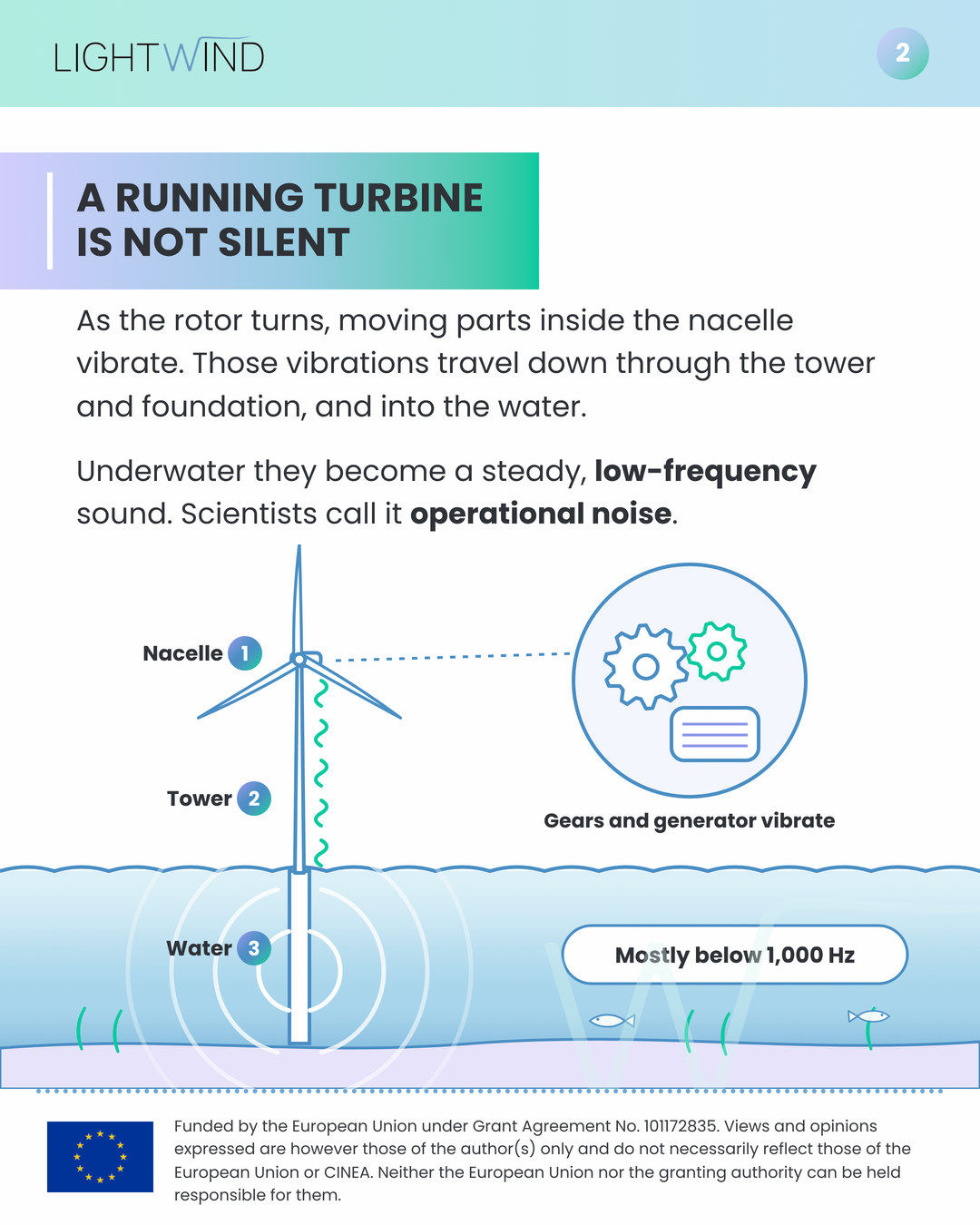
A turbine’s rotor turns a drivetrain, the set of components that converts rotation into electricity. These moving parts vibrate as they work. The vibration travels down through the tower and foundation, then spreads into the water as sound.
Scientists call this operational noise. Most of it sits at low frequencies, below about 1,000 hertz (Tougaard et al., 2020). Think of a hum rather than a bang.
Why underwater noise from offshore wind matters
Sound travels further and faster in water than in air. For this reason, many marine animals depend on it. Porpoises, seals and many fish use sound to communicate, find food and find their way.
Building a wind farm can be very loud, especially when crews hammer piles into the seabed. By comparison, operational noise is far quieter (University of Rhode Island). However, it continues for as long as the turbines run. That is why researchers want to understand it well.
Three factors that shape the level
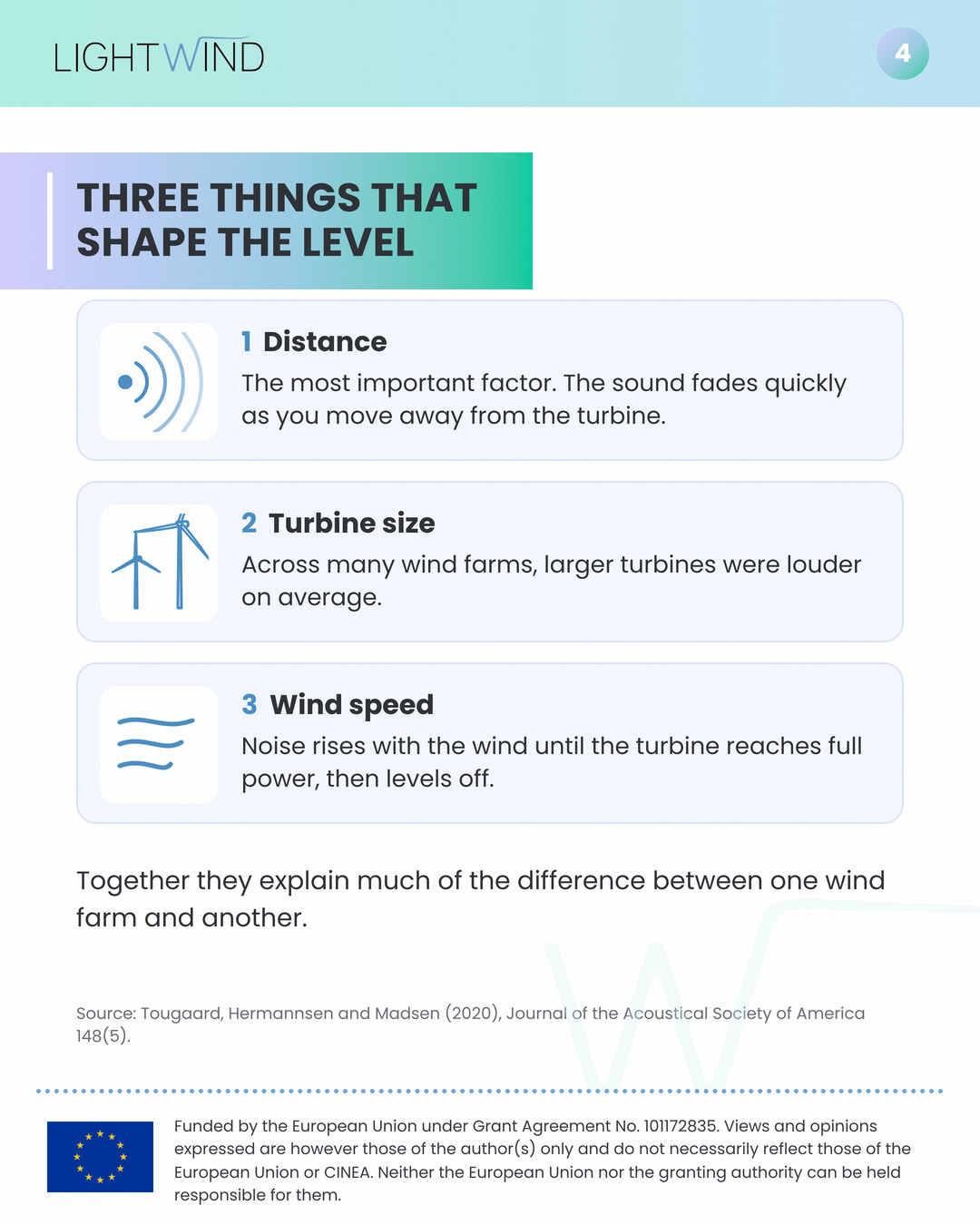
A 2020 study compared measurements from many offshore wind farms. It found three main factors.
First, distance matters most. The sound drops off steeply as you move away from a turbine.
Next comes turbine size. Larger turbines were louder on average. Turbines have also grown a great deal over the past three decades.
Finally, wind speed plays a smaller role. Noise rises as the wind picks up, until the turbine reaches full power. After that, it levels off.
The drivetrain leaves a fingerprint
Most turbines measured so far use a gearbox. When gear teeth mesh, they create distinct tones that stand out in recordings. Turbines without a gearbox, called direct drive, are expected to lack these tones. In fact, a modelling study suggests direct drive turbines could be noticeably quieter. Measured data on direct drive turbines are still limited, though.
This link between drivetrain design and underwater sound is one reason environmental questions belong next to engineering ones. Our explainer on modular drivetrains shows how design choices also shape maintenance at sea.
Floating turbines bring new sounds
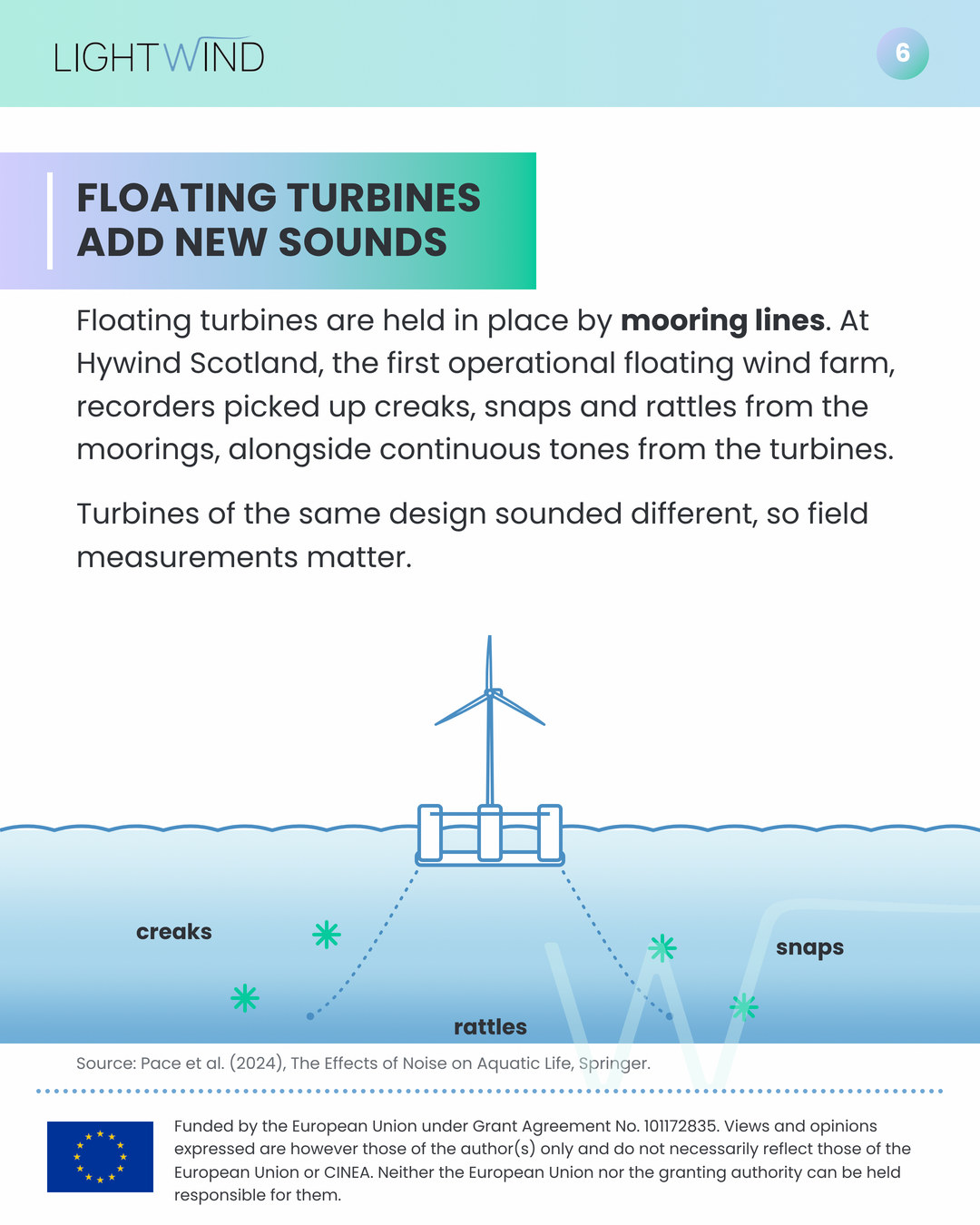
Floating offshore wind turbines are not fixed to the seabed. Instead, mooring lines hold them in place. At Hywind Scotland, the first operational floating wind farm, researchers recorded the site for four months (Pace et al., 2024). They heard continuous tones linked to turbine operation. They also heard creaks, snaps and rattles from the moorings.
Turbines of the same design did not sound the same. Mooring noise also proved hard to predict with models. As a result, the researchers concluded that impact assessments need field measurements.
How LIGHTWIND is looking at this
LIGHTWIND is developing a lighter, modular drivetrain for floating offshore wind turbines. Alongside the engineering work, the project assesses social and environmental effects. Researchers at the Hellenic Centre for Marine Research (HCMR) are estimating how far operational noise from new design floating turbines could extend. They will present this work at HydroMediT 2026 in Volos, Greece, from 5 to 8 November.
Want to follow the results? Read the latest updates in our news section, or follow LIGHTWIND on LinkedIn and Bluesky.
Sources
Tougaard, J., Hermannsen, L. and Madsen, P.T. (2020). How loud is the underwater noise from operating offshore wind turbines? Journal of the Acoustical Society of America, 148(5), pages 2885 to 2893.
Stober, U. and Thomsen, F. (2021). How could operational underwater sound from future offshore wind turbines impact marine life? Journal of the Acoustical Society of America, 149, pages 1791 to 1795.
Pace, F. et al. (2024). Underwater sound emissions from the moorings of floating wind turbines: Hywind Scotland case study. The Effects of Noise on Aquatic Life, Springer.
University of Rhode Island. What sounds are associated with the construction and operation of offshore wind farms?